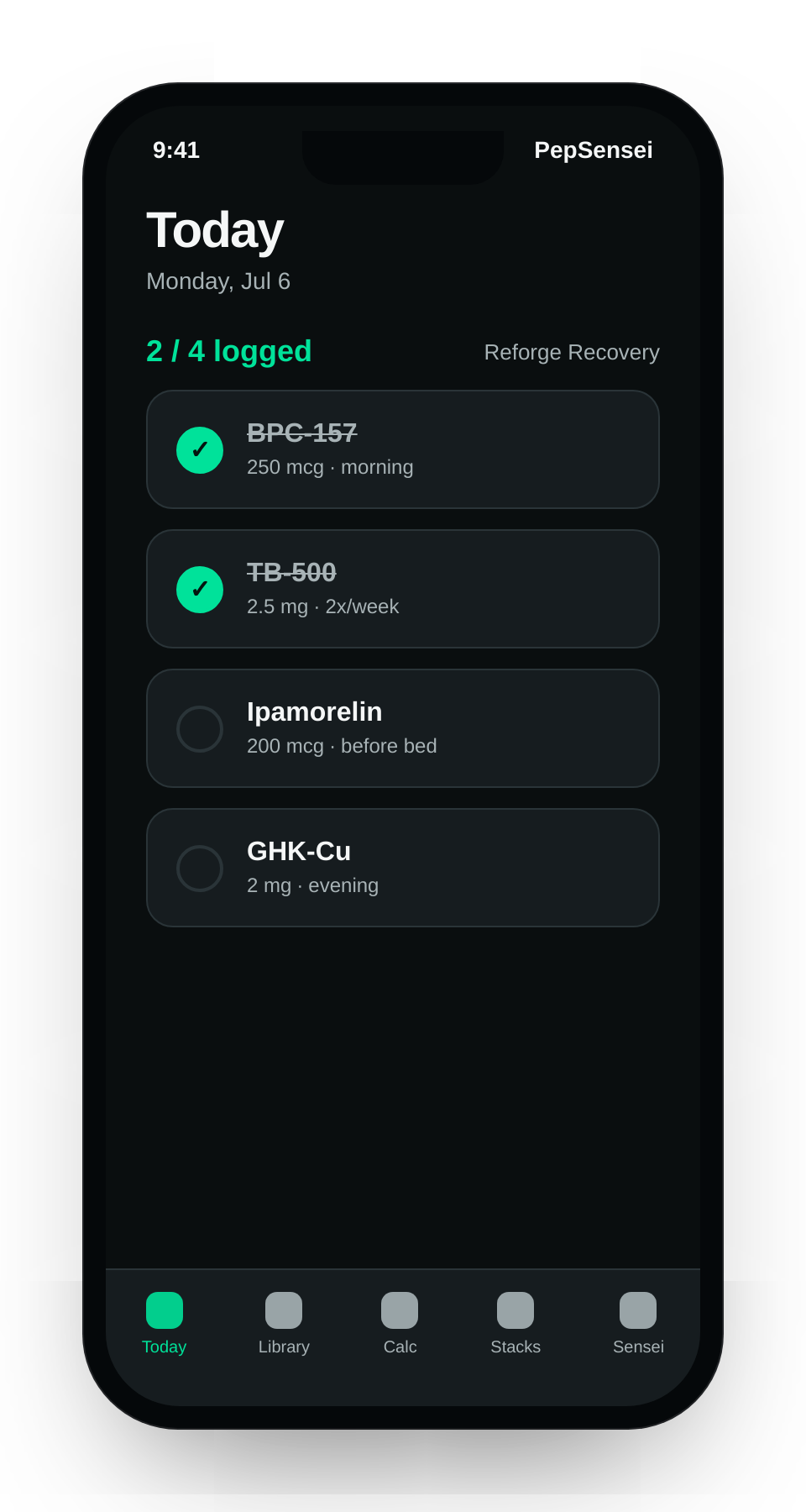
The peptide tracker,
with a sensei.
Build any stack. Nail the reconstitution math. Log every dose. A precise, private companion — with a guide built in.
Precision, not guesswork.
Three tools that replace the spreadsheet, the group-chat advice, and the mental math.
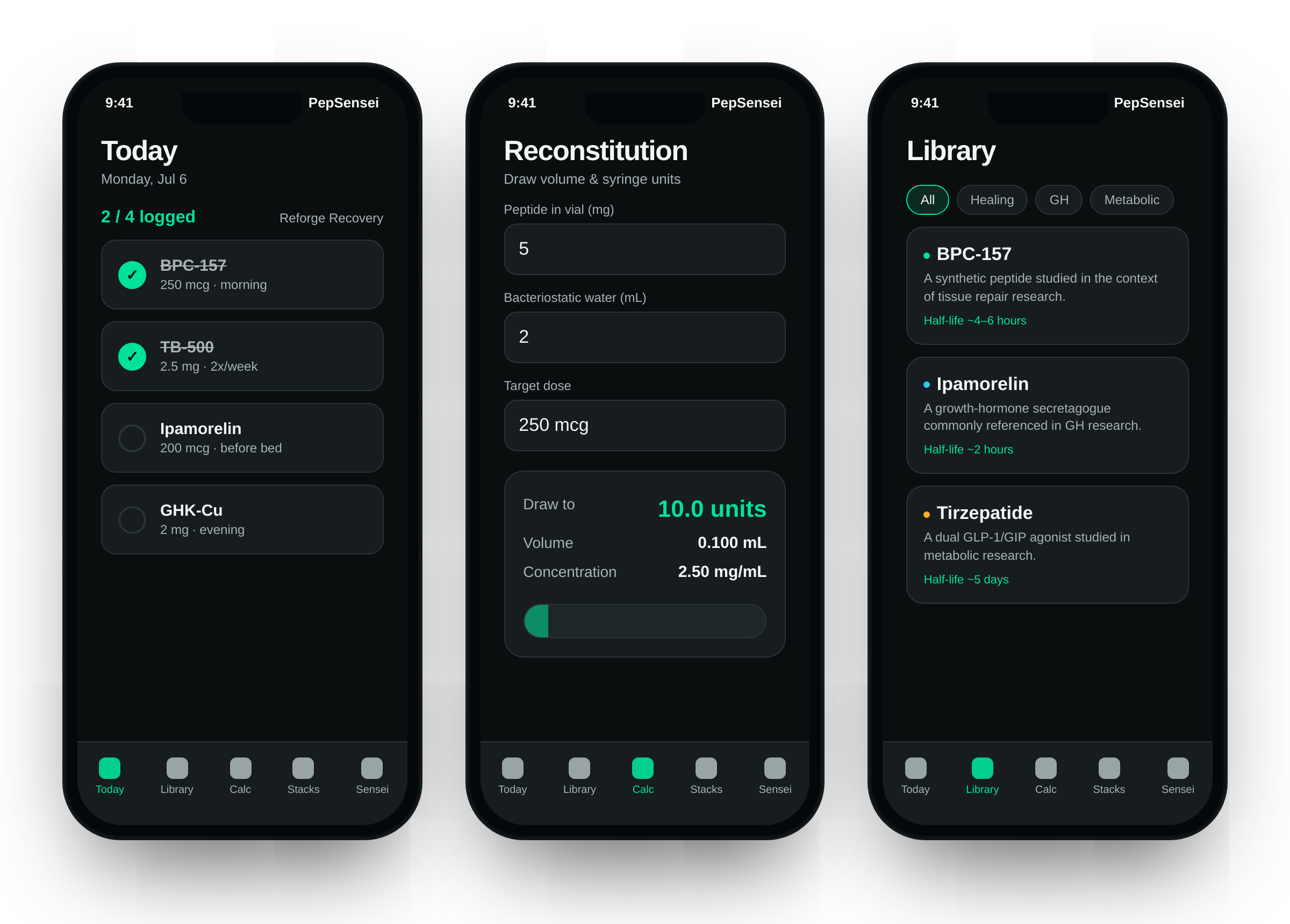
Every peptide.
An educational library across five categories — half-life, routes, and reconstitution defaults for each compound.
Reconstitution, solved.
Vial mg + water in, exact draw volume and syringe units out. No more spreadsheet errors on the one number that matters.
Your protocol guide.
An educational advisor that knows your stack — explains compounds, timing, and math. Never medical advice, always in context.
Built like protocols.
Reference stacks you can explore and import in one tap.
Reforge Recovery Stack
4-8 weeksThis pairing brings together BPC-157 and TB-500, the two compounds most frequently co-referenced in connective-tissue and recovery research literature. It is an educational example of how a short-half-life and a long-half-life repair peptide are studied together in research contexts.
Twilight Composition Stack
8-12 weeksThis example pairs Tesamorelin, a GHRH analog, with Ipamorelin, a selective secretagogue, two compounds commonly studied together in growth-hormone-axis research. Research literature frequently references before-bed timing for this class of compound.
Metabolic Reset Stack
12-24 weeks with titrationThis example centers on the Cagri-Sema blend, which combines an amylin analog with a GLP-1 receptor agonist. It illustrates how two mechanistically distinct metabolic compounds are studied together in appetite-regulation research, with the literature referencing gradual weekly titration.
Cellular Renewal Stack
4-8 weeksThis example brings together NAD+, a coenzyme central to cellular energy metabolism, and MOTS-c, a mitochondrial-derived peptide. Both are commonly referenced in longevity and mitochondrial-signaling research, making them a natural educational pairing in this category.
Radiance Aesthetic Stack
4-8 weeksThis example pairs GHK-Cu, a copper peptide referenced in skin and connective-tissue research, with Melanotan II, a melanocortin agonist studied in pigmentation research. It is an educational illustration of two compounds referenced in aesthetics-adjacent research contexts.
By category.
Healing & Repair
Peptides frequently referenced in connective-tissue, gastrointestinal, and recovery-focused research literature.
Growth Hormone
Compounds studied in the context of the growth-hormone axis and related signaling pathways.
Metabolic
Incretin- and amylin-class compounds commonly referenced in metabolic and appetite-regulation research.
Longevity
Compounds studied in the context of cellular energy, mitochondrial signaling, and aging research.
Brain & Mood
Peptides referenced in neurological, behavioral, and melanocortin-pathway research.
Good to know.
Is PepSensei medical advice?
No. PepSensei is an educational tracking and reference tool. Nothing in it is medical advice, and it is not intended to diagnose, treat, cure, or prevent anything. Always consult a licensed professional.
Where is my data stored?
On your device by default. Your protocols and logs live in on-device storage — an optional account lets you back up and sync across devices, encrypted.
What does the reconstitution calculator do?
You enter the peptide amount in the vial and the bacteriostatic water you added; it returns the exact draw volume and the units on a U-100 insulin syringe for your target dose.
When is it available?
iOS and Android are in development. Join the waitlist and you will be first into the beta.
Start logging with precision.
Be first to the iOS and Android beta. No spam — just the launch.